Olympic Flag
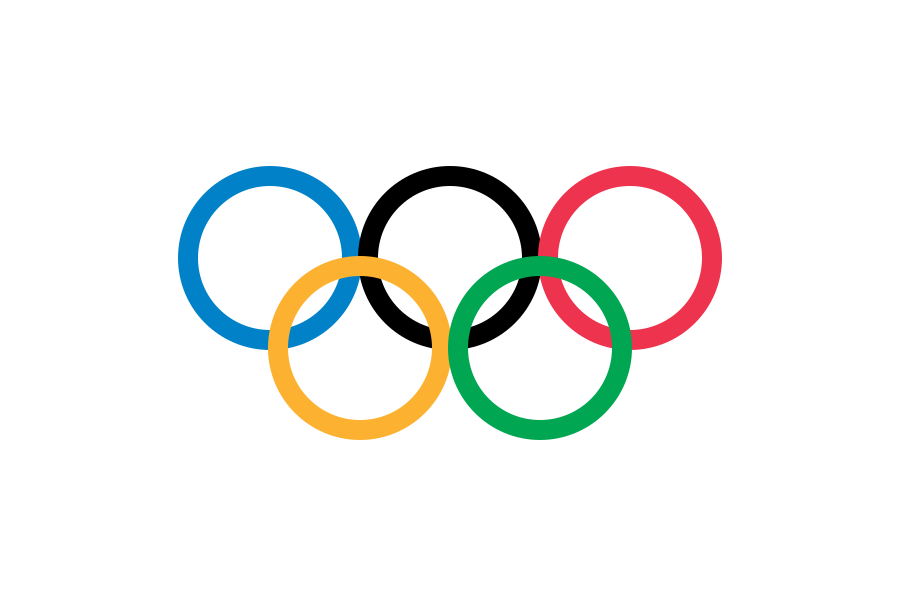
International Organisation FlagsDesigned by Pierre de Coubertin in 1913 and first flown at the 1920 Antwerp Games.
Basic Flag Information
| Flag Name | Olympic Flag |
|---|---|
| Category | International Organisation Flags |
| Adopted On | 1914 |
| Designer | Pierre de Coubertin |
| Flag Proportion | 2:3 |
| Flag Shape | Rectangle |
| Number of Colors | 6 |
| Main Colors | Blue, Yellow, Black, Green, Red, White |
| Design Type | White field with five interlaced rings |
Flag Color Information
| Color | Appearance | HEX Code |
|---|---|---|
| Blue | #0081C8 | |
| Yellow | #FCB131 | |
| Black | #000000 | |
| Green | #00A651 | |
| Red | #EE334E | |
| White | #FFFFFF |
Flag Design and Symbols
| Blue colour | Represents one of the ring colours |
|---|---|
| Yellow colour | Represents one of the ring colours |
| Black colour | Represents one of the ring colours |
| Green colour | Represents one of the ring colours |
| Red colour | Represents one of the ring colours |
| White colour | Represents the field |
| Five interlaced rings | The five inhabited continents brought together |
| Six colours | The five ring colours plus the white field were chosen because every national flag of the time contained at least one of them |
Facts about the Flag of Olympic Flag
- Pierre de Coubertin designed the five interlocking rings in 1913, and the flag was first flown at the 1920 Antwerp Games.
- The six colours — blue, yellow, black, green, red and the white background — were chosen because at least one appeared on every national flag then in existence. The rings do not represent specific continents by colour.
- Designed by Pierre de Coubertin in 1913 and first flown at the 1920 Antwerp Games.
- The flag belongs to the Olympic Movement. It is used worldwide.
- It was founded in 1913, when Pierre de Coubertin designed the rings by Pierre de Coubertin.
- It is based in Lausanne.
- It is raised at the opening ceremony of every Olympic Games and lowered at the closing ceremony.
- The flag was adopted in 1914. It was designed by Pierre de Coubertin.
- The design is 112 years old as of 2026.
- Construction: White field with five interlaced rings.
- It is normally drawn to a ratio of 2:3, which makes it rectangular.
- The flag uses 6 colours: blue, yellow, black, green, red and white.
- The blue stands for one of the ring colours.
- The yellow stands for one of the ring colours.
- The black stands for one of the ring colours.
- The green stands for one of the ring colours.
- Five interlaced rings: The five inhabited continents brought together.
- Six colours: The five ring colours plus the white field were chosen because every national flag of the time contained at least one of them.
Frequently asked questions about the Olympic Flag
What is the Olympic Flag?
Designed by Pierre de Coubertin in 1913 and first flown at the 1920 Antwerp Games.
Whose flag is the Olympic Flag?
It is the flag of the Olympic Movement, used worldwide.
When was the Olympic Movement founded?
The Olympic Movement was founded in 1913, when Pierre de Coubertin designed the rings by Pierre de Coubertin.
When was the Olympic Flag adopted?
The Olympic Flag was adopted in 1914 and was designed by Pierre de Coubertin.
What do the colours of the Olympic Flag mean?
Blue for one of the ring colours, yellow for one of the ring colours, black for one of the ring colours, green for one of the ring colours, red for one of the ring colours and white for the field.
What do the symbols on the Olympic Flag mean?
Five interlaced rings — The five inhabited continents brought together. Six colours — The five ring colours plus the white field were chosen because every national flag of the time contained at least one of them.
Where is the Olympic Flag flown?
It is raised at the opening ceremony of every Olympic Games and lowered at the closing ceremony.
Where is it based and how large is it?
It is based in Lausanne.
What are the proportions of the Olympic Flag?
It is normally drawn to a ratio of 2:3, which makes it rectangular.
What else is worth knowing about the Olympic Flag?
It was first flown at the 1920 Antwerp Games. The five rings stand for the five inhabited continents, and the six colours including the white field were chosen because at least one appears on every national flag.