European Union Flag
International Organisation FlagsAdopted by the Council of Europe in 1955 and taken up by the European Communities in 1985.
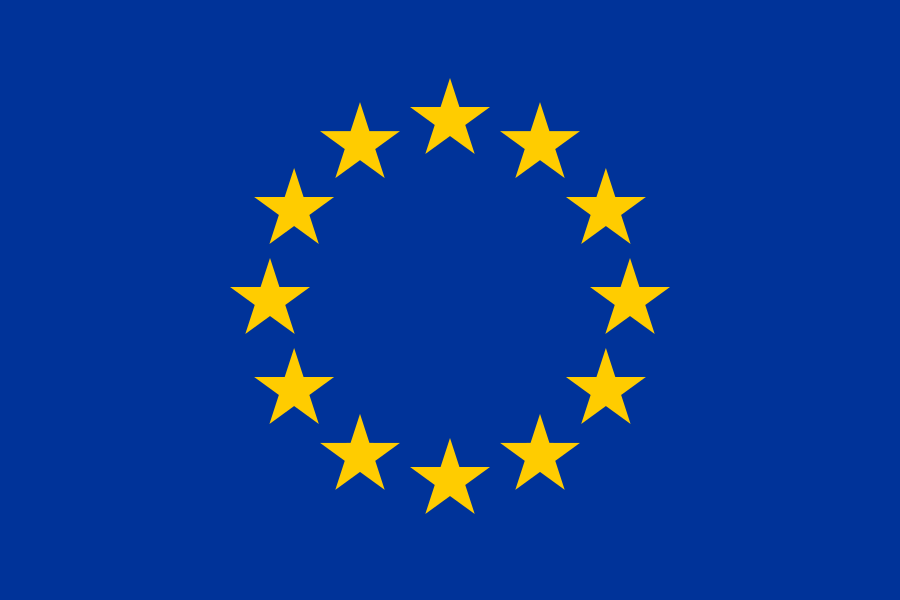
Basic Flag Information
| Flag Name | European Union Flag |
|---|---|
| Category | International Organisation Flags |
| Adopted On | December 8, 1955 |
| Designer | Arsène Heitz and Paul Lévy |
| Flag Proportion | 2:3 |
| Flag Shape | Rectangle |
| Number of Colors | 2 |
| Main Colors | Reflex Blue, Gold |
| Design Type | Blue field with a circle of twelve gold stars |
Flag Color Information
| Color | Appearance | HEX Code |
|---|---|---|
| Reflex Blue | #003399 | |
| Gold | #FFCC00 |
Flag Design and Symbols
| Reflex Blue colour | Represents the western sky |
|---|---|
| Gold colour | Represents the stars |
| Twelve stars | Not the number of member states — twelve is a traditional symbol of completeness and unity, and the number has never changed |
Facts about the Flag of European Union Flag
- The twelve stars have never represented twelve member states. The circle was designed for the Council of Europe in 1955, with twelve chosen as a traditional number of completeness.
- The count has stayed fixed through every enlargement, which is why it does not track membership.
- The European Communities adopted the same flag in 1985, so two separate organisations use it.
- Adopted by the Council of Europe in 1955 and taken up by the European Communities in 1985.
- The flag belongs to the European Union. It is used in Europe.
- It was founded on 1 November 1993, when the Maastricht Treaty took effect.
- It is based in Brussels, with the Parliament also sitting in Strasbourg.
- It has 27 member states.
- The flag was adopted in December 8, 1955. It was designed by Arsène Heitz and Paul Lévy.
- The design is 71 years old as of 2026.
- Construction: Blue field with a circle of twelve gold stars.
- It is normally drawn to a ratio of 2:3, which makes it rectangular.
- The flag uses 2 colours: reflex blue and gold.
- The reflex blue stands for the western sky.
- The gold stands for the stars.
- Twelve stars: Not the number of member states — twelve is a traditional symbol of completeness and unity, and the number has never changed.
- The flag is older than the Union itself: the Council of Europe adopted it in 1955 and the European Communities took it up in 1985. The twelve stars are a number of completeness and have never stood for the number of members.
- It is filed here under International Organisation Flags, one of the categories of flag that belong to no country.
Frequently asked questions about the European Union Flag
What is the European Union Flag?
Adopted by the Council of Europe in 1955 and taken up by the European Communities in 1985.
Whose flag is the European Union Flag?
It is the flag of the European Union, used in Europe.
When was the European Union founded?
The European Union was founded on 1 November 1993, when the Maastricht Treaty took effect.
When was the European Union Flag adopted?
The European Union Flag was adopted in December 8, 1955 and was designed by Arsène Heitz and Paul Lévy.
What do the colours of the European Union Flag mean?
Reflex blue for the western sky and gold for the stars.
What do the symbols on the European Union Flag mean?
Twelve stars — Not the number of member states — twelve is a traditional symbol of completeness and unity, and the number has never changed.
Where is it based and how large is it?
It is based in Brussels, with the Parliament also sitting in Strasbourg and it has 27 member states.
What are the proportions of the European Union Flag?
It is normally drawn to a ratio of 2:3, which makes it rectangular.
What else is worth knowing about the European Union Flag?
The flag is older than the Union itself: the Council of Europe adopted it in 1955 and the European Communities took it up in 1985. The twelve stars are a number of completeness and have never stood for the number of members.
Is the European Union Flag a national flag?
No. It is not the flag of any sovereign state and is listed here under International Organisation Flags.