Nishan Sahib (Sikh Flag)
Religious FlagsThe flag flown at every Gurdwara, its origins traced to Guru Hargobind and the founding of the Khalsa in 1699.
Basic Flag Information
| Flag Name | Nishan Sahib (Sikh Flag) |
|---|---|
| Category | Religious Flags |
| Adopted On | 1699 |
| Flag Proportion | 2:3 |
| Flag Shape | Rectangle |
| Number of Colors | 2 |
| Main Colors | Saffron, Dark Blue |
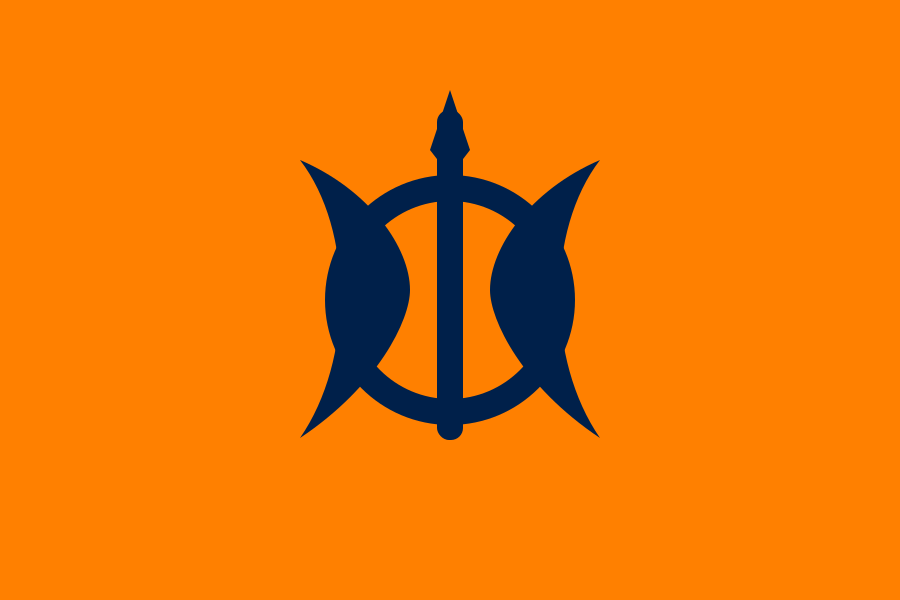
| Design Type | Saffron field with the Khanda emblem |
Flag Color Information
| Color | Appearance | HEX Code |
|---|---|---|
| Saffron | #FF8000 | |
| Dark Blue | #00204A |
Flag Design and Symbols
| Saffron colour | Represents sacrifice, courage and the Sikh spirit |
|---|---|
| Dark Blue colour | Represents the Khanda emblem |
| Khanda | A double-edged sword for divine knowledge, a chakkar for the oneness of God, and two kirpans for spiritual and temporal authority |
Facts about the Flag of Nishan Sahib (Sikh Flag)
- The triangular saffron flag flies outside every gurdwara, and its pole is wrapped in cloth that is ceremonially replaced each year.
- The khanda emblem in the centre combines a double-edged sword, a circle and two curved swords, each with its own meaning in Sikh tradition.
- The flag flown at every Gurdwara, its origins traced to Guru Hargobind and the founding of the Khalsa in 1699.
- The flag belongs to Sikhism. It is used worldwide, with roots in Punjab.
- It was founded in the seventeenth century, in the time of Guru Hargobind.
- It flies outside every gurdwara in the world, and the cloth is ceremonially changed each year at Baisakhi.
- The flag was adopted in 1699.
- The design is 327 years old as of 2026.
- Construction: Saffron field with the Khanda emblem.
- It is normally drawn to a ratio of 2:3, which makes it rectangular.
- The flag uses 2 colours: saffron and dark blue.
- The saffron stands for sacrifice, courage and the Sikh spirit.
- The dark blue stands for the Khanda emblem.
- Khanda: A double-edged sword for divine knowledge, a chakkar for the oneness of God, and two kirpans for spiritual and temporal authority.
- The Khanda emblem combines a double-edged sword, a circle and two curved swords standing for spiritual and temporal authority.
- It is filed here under Religious Flags, one of the categories of flag that belong to no country.
Frequently asked questions about the Nishan Sahib (Sikh Flag)
What is the Nishan Sahib (Sikh Flag)?
The flag flown at every Gurdwara, its origins traced to Guru Hargobind and the founding of the Khalsa in 1699.
Whose flag is the Nishan Sahib (Sikh Flag)?
It is the flag of Sikhism, used worldwide, with roots in Punjab.
When was Sikhism founded?
Sikhism was founded in the seventeenth century, in the time of Guru Hargobind.
When was the Nishan Sahib (Sikh Flag) adopted?
The Nishan Sahib (Sikh Flag) was adopted in 1699.
What do the colours of the Nishan Sahib (Sikh Flag) mean?
Saffron for sacrifice, courage and the Sikh spirit and dark blue for the Khanda emblem.
What do the symbols on the Nishan Sahib (Sikh Flag) mean?
Khanda — A double-edged sword for divine knowledge, a chakkar for the oneness of God, and two kirpans for spiritual and temporal authority.
Where is the Nishan Sahib (Sikh Flag) flown?
It flies outside every gurdwara in the world, and the cloth is ceremonially changed each year at Baisakhi.
What are the proportions of the Nishan Sahib (Sikh Flag)?
It is normally drawn to a ratio of 2:3, which makes it rectangular.
What else is worth knowing about the Nishan Sahib (Sikh Flag)?
The Khanda emblem combines a double-edged sword, a circle and two curved swords standing for spiritual and temporal authority.
Is the Nishan Sahib (Sikh Flag) a national flag?
No. It is not the flag of any sovereign state and is listed here under Religious Flags.