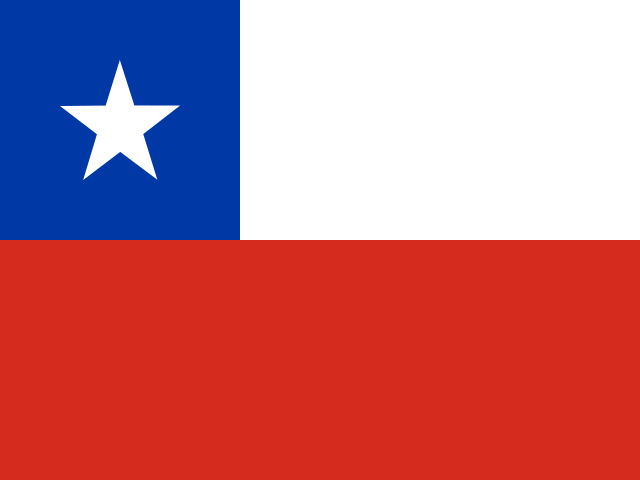
Flag of Chile
countryThe flag of Chile was adopted on October 18, 1817. Horizontal bicolour with a blue canton and white star. It uses 3 colours: blue, white and red. The official proportions are 2:3.
Basic Flag Information
| Flag Name | Flag of Chile |
|---|---|
| Country | Chile |
| Official Country Name | Republic of Chile |
| Capital | Santiago |
| Continent | Americas |
| Region | South America |
| ISO Country Code | CL / CHL |
| Internet Domain | .cl |
| Calling Code | +56 |
| Currency | Chilean peso (CLP) |
| National Language(s) | Spanish |
| Demonym | Chilean |
| Area | 756,102 km² |
| Population | 20 million (2025 est.) |
Flag Specifications
| Official Flag Name | Flag of Chile |
|---|---|
| Adopted On | October 18, 1817 |
| First Used | 1817 |
| Current Version Adopted | October 18, 1817 |
| Flag Proportion | 2:3 |
| Flag Shape | Rectangle |
| Number of Colors | 3 |
| Main Colors | Blue, White, Red |
| Design Type | Horizontal bicolour with a blue canton and white star |
| Official Status | Official National Flag |
| Government Authority | Government of Chile |
Flag Color Information
| Color | Appearance | HEX Code | RGB | CMYK |
|---|---|---|---|---|
| Blue | #0039A6 | 0, 57, 166 | 100, 66, 0, 35 | |
| White | #FFFFFF | 255, 255, 255 | 0, 0, 0, 0 | |
| Red | #D52B1E | 213, 43, 30 | 0, 80, 86, 16 |
Flag Design and Symbols
| Blue colour | Represents the sky and the Pacific Ocean |
|---|---|
| White colour | Represents the snow of the Andes |
| Red colour | Represents the blood shed for independence |
| Lone star | A guide on the path to progress and honour — the flag is nicknamed La Estrella Solitaria |
Flag History
| Year / Period | Event |
|---|---|
| 1817 | The design was first used |
| 1817-10-18 | The current flag was officially adopted |
| Present | The flag remains in official use |
| Present | The flag remains in official use |
Flag Dimensions and Construction
| Official Ratio | 2:3 |
|---|---|
| Width | 2 units (hoist) |
| Length | 3 units (fly) |
Chile Flag Usage
| Government Buildings | Yes |
|---|---|
| Schools | Yes |
| Civil Use | Yes |
| Official Ceremonies | Yes |
| Sports Events | Yes |
| National Holidays | Yes |
| Military | Yes |
| Naval Use | Yes |
| Embassies | Yes |
| International Events | Yes |
Other Official Flags of Chile
| Flag Type | Use | Link |
|---|---|---|
| National Flag | National representation | View flag |
| Civil Flag | Used by civilians | View flag |
| State Flag | Used by government | View flag |
| War Flag | Used during military operations | View flag |
| Naval Ensign | Used by the navy | View flag |
| Air Force Flag | Used by the air force | View flag |
| Presidential Standard | Used by the head of state | View flag |
| Royal Standard | Used by the monarch | View flag |
| Historical Flag | Previous national flag | View flag |
Quick Facts About the Flag
| Flag Age | 209 years old as of 2026 |
|---|---|
| Adoption Date | October 18, 1817 |
| Oldest Version | 1817 |
| Flag Nickname | La Estrella Solitaria |
| Most Common Color | Blue |
| Unique Feature | Horizontal bicolour with a blue canton and white star |
Facts about the Flag of Chile
- The lone star is called La Estrella Solitaria and stands for a unitary state rather than a federation — the opposite of what a single star usually means on a flag.
- Chilean law is unusually strict about display: the flag has fixed rules on hoisting and lowering times, and misuse has historically carried a fine.
- The resemblance to the flag of Texas is coincidental. Chile's design dates from 1817, Texas's from 1839, and no borrowing has ever been demonstrated.
- The flag of Chile was officially adopted on October 18, 1817.
- The flag in its present form is 209 years old as of 2026.
- Design type: Horizontal bicolour with a blue canton and white star.
- The flag is known as La Estrella Solitaria, a name used far more often than the formal "flag of Chile".
- The official proportions are 2:3. It shares that ratio with 82 national flags.
- The flag uses 3 colours: blue, white and red.
- The blue on the flag stands for the sky and the Pacific Ocean.
- The white on the flag stands for the snow of the Andes.
- The red on the flag stands for the blood shed for independence.
- Lone star: A guide on the path to progress and honour — the flag is nicknamed La Estrella Solitaria.
- Chile became independent on 12 February 1818 from Spain.
- The first junta of 18 September 1810 is the date Chile celebrates.
- Chilean rodeo is the official national sport; football is the most popular.
- The national animal is the huemul and Andean condor, the two supporters of the coat of arms.
- The national anthem is "Himno Nacional de Chile".
Frequently Asked Questions about the Flag of Chile
When was the flag of Chile adopted?
The flag of Chile was officially adopted on October 18, 1817.
What do the colours of the flag of Chile mean?
Blue for the sky and the Pacific Ocean, white for the snow of the Andes and red for the blood shed for independence.
When did Chile gain independence?
Chile became independent on 12 February 1818 from Spain. The first junta of 18 September 1810 is the date Chile celebrates.
What is the national sport of Chile?
Chilean rodeo is the official national sport; football is the most popular.
What do the symbols on the flag of Chile represent?
Lone star — A guide on the path to progress and honour — the flag is nicknamed La Estrella Solitaria.
What are the proportions of the flag of Chile?
The official ratio is 2:3, which makes the flag rectangular. It shares those proportions with 82 national flags.
What is the national anthem of Chile?
The national anthem is "Himno Nacional de Chile".
When is the national day of Chile?
It falls on 18 September, Fiestas Patrias, and the flag is flown across the country.
What is the national animal of Chile?
The national animal is the huemul and Andean condor, the two supporters of the coat of arms.
What is the capital of Chile?
The capital is Santiago. The currency is the Chilean peso (CLP) and the language spoken is Spanish.