
Flag of Canada
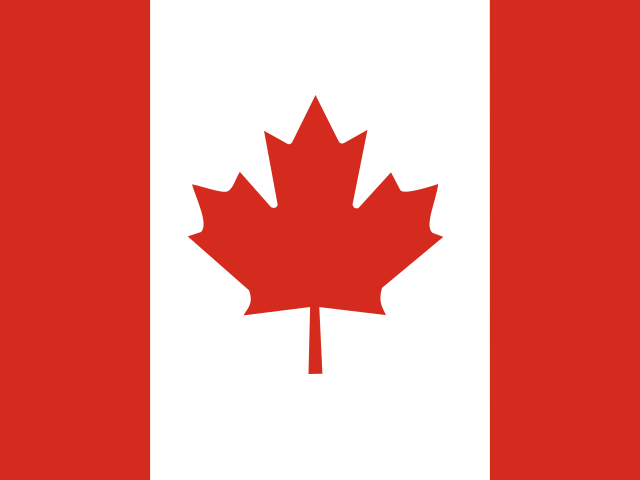
CountryFlag of Canada uses canadian pale with a red maple leaf. Ratio 1:2, current adoption February 15, 1965 and design credited to George F. G. Stanley, with John Matheson.
Flag Reference
| Flag | Flag of Canada |
|---|---|
| Entity Type | Country |
| Identifier | CA / CAN |
| Region | North America |
Flag Specifications
| Current Adoption | February 15, 1965 |
|---|---|
| First Documented Use | 1965 |
| Proportion | 1:2 |
| Shape | Rectangle |
| Colours | Red, White |
| Designer | George F. G. Stanley, with John Matheson |
| Construction | Canadian pale with a red maple leaf |
| Common Name | The Maple Leaf |
Documented Colour Values
| Colour | Appearance | HEX | RGB | CMYK |
|---|---|---|---|---|
| Red | #D52B1E | 213, 43, 30 | 0, 80, 86, 16 | |
| White | #FFFFFF | 255, 255, 255 | 0, 0, 0, 0 |
Design and Symbolism
| Red | one of Canada’s two official colours since 1921. |
|---|---|
| White | the pale, and one of the two official colours. |
| Eleven-point maple leaf | The national symbol; the number of points has no meaning and was chosen because it stayed crisp in a wind tunnel test. |
| Canadian pale | A square-ended vertical band twice the width of the side bands — a division named after this flag. |
Proportions
| Ratio | 1:2 |
|---|---|
| Hoist | 1 units |
| Fly | 2 units |
Verification sources
- Flags of the World — Canada — Specialist vexillological reference
Facts about the Flag of Canada
- Canada is recorded as canadian pale with a red maple leaf.
- The reference proportion for the flag of Canada is 1:2.
- The stored palette for Canada contains Red and White.
- The adoption field for this country flag record is February 15, 1965.
- The design record traces first use to 1965.
- George F. G. Stanley, with John Matheson is credited in the dataset as the designer of the flag.
- Its construction is grouped with the canadian pale design family in this library.
- Eleven-point maple leaf: The national symbol; the number of points has no meaning and was chosen because it stayed crisp in a wind tunnel test.
- Canadian pale: A square-ended vertical band twice the width of the side bands — a division named after this flag.
- The Great Flag Debate of 1964 ran for six months and more than two hundred and fifty speeches before parliament forced a vote. The maple leaf replaced the Canadian Red Ensign, which had never been formally adopted at all.
- The eleven-pointed leaf is not botanically accurate. Earlier designs with thirteen points blurred at speed in wind tunnel testing, so the count was reduced until the shape stayed legible.
Frequently Asked Questions about the Flag of Canada
What does the flag of Canada look like?
Canadian pale with a red maple leaf, with a recorded proportion of 1:2.
What proportion is recorded for the flag of Canada?
The reference proportion stored for this flag is 1:2.
Which colours are recorded for the flag of Canada?
The reference palette lists Red #D52B1E and White #FFFFFF.
What do the symbols on the flag of Canada represent?
Eleven-point maple leaf — The national symbol; the number of points has no meaning and was chosen because it stayed crisp in a wind tunnel test. Canadian pale — A square-ended vertical band twice the width of the side bands — a division named after this flag.
When was the present flag record for Canada adopted?
The adoption field in this record is February 15, 1965.
Who designed the flag of Canada?
The designer is recorded as George F. G. Stanley, with John Matheson.
Which design family does the flag of Canada belong to?
WorldFlags.online groups it with canadian pale designs for visual browsing; that classification describes construction, not necessarily historical ancestry.