
Flag of Burkina Faso
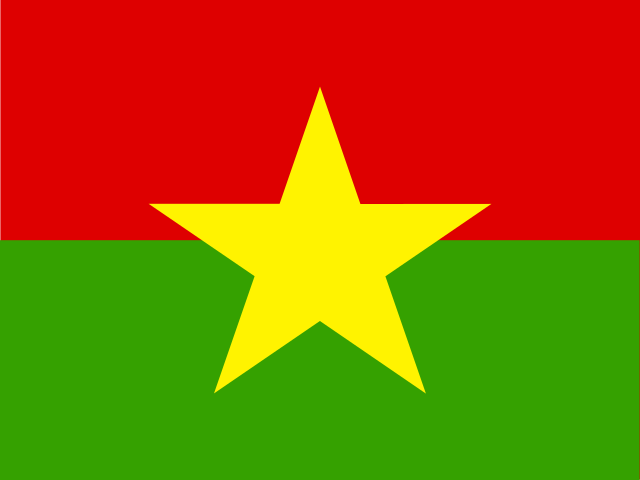
CountryFlag of Burkina Faso uses horizontal bicolour with centred star. Ratio 2:3 and current adoption August 4, 1984.
Flag Reference
| Flag | Flag of Burkina Faso |
|---|---|
| Entity Type | Country |
| Identifier | BF / BFA |
| Region | Western Africa |
Flag Specifications
| Current Adoption | August 4, 1984 |
|---|---|
| First Documented Use | 1984 |
| Proportion | 2:3 |
| Shape | Rectangle |
| Colours | Red, Green, Yellow |
| Construction | Horizontal bicolour with centred star |
Documented Colour Values
| Colour | Appearance | HEX | RGB | CMYK |
|---|---|---|---|---|
| Red | #EF2B2D | 239, 43, 45 | 0, 82, 81, 6 | |
| Green | #009E49 | 0, 158, 73 | 100, 0, 54, 38 | |
| Yellow | #FCD116 | 252, 209, 22 | 0, 17, 91, 1 |
Design and Symbolism
| Red | the revolution. |
|---|---|
| Green | hope and the country’s natural riches. |
| Yellow | the mineral wealth of the nation. |
| Yellow star | The guiding light of the revolution. |
Proportions
| Ratio | 2:3 |
|---|---|
| Hoist | 2 units |
| Fly | 3 units |
Verification sources
- Flags of the World — Burkina Faso — Specialist vexillological reference
Other horizontal bicolour flags
See all

Facts about the Flag of Burkina Faso
- Burkina Faso is recorded as horizontal bicolour with centred star.
- The reference proportion for the flag of Burkina Faso is 2:3.
- The stored palette for Burkina Faso contains Red, Green and Yellow.
- The adoption field for this country flag record is August 4, 1984.
- The design record traces first use to 1984.
- Its construction is grouped with the horizontal bicolour design family in this library.
- Yellow star: The guiding light of the revolution.
- The flag was adopted in 1984 when Upper Volta was renamed Burkina Faso, replacing a black-white-red tricolour that referenced the three branches of the Volta river.
- The red, green and gold star places the country squarely in the Pan-African tradition established by Ghana.
Frequently Asked Questions about the Flag of Burkina Faso
What does the flag of Burkina Faso look like?
Horizontal bicolour with centred star, with a recorded proportion of 2:3.
What proportion is recorded for the flag of Burkina Faso?
The reference proportion stored for this flag is 2:3.
Which colours are recorded for the flag of Burkina Faso?
The reference palette lists Red #EF2B2D, Green #009E49 and Yellow #FCD116.
What do the symbols on the flag of Burkina Faso represent?
Yellow star — The guiding light of the revolution.
When was the present flag record for Burkina Faso adopted?
The adoption field in this record is August 4, 1984.
Which design family does the flag of Burkina Faso belong to?
WorldFlags.online groups it with horizontal bicolour designs for visual browsing; that classification describes construction, not necessarily historical ancestry.
Where can I verify information about the flag of Burkina Faso?
The verification-source section on this page links to an official, governmental or specialist reference used to check the underlying record. Source wording is not copied into the article.